Trade & Supply Chains

19 September 2026

How goods move around the world. Shipping rates, port delays, route problems, raw materials, choke points and export bans. The subject is goods in transit.

Trade & Supply Chains

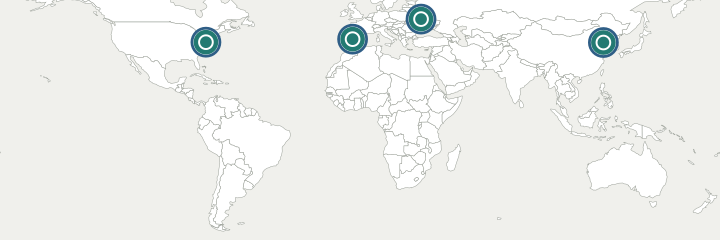
Map of United States of America, China, South Korea, Spain, Ukraine
Key people

Donald Trump

2 stories

Kazakhstan Turns to Russian Gas as Domestic Demand Surges

OilPrice.com · 2026-09-18 · full_text

Kazakhstan has agreed to increase natural gas imports from Russia to 11 billion cubic meters in 2026, up from 4 bcm in 2025, under a new supplementary agreement with Gazprom. Domestic demand in Kazakhstan is surging despite record domestic production of 68.1 bcm in 2025. The purchase price is likely discounted because Russia needs revenue for its war effort in Ukraine and has lost European markets. A US sanctions bill passed on September 16 could disrupt these import plans and expose Central Asian entities to secondary sanctions. Uzbekistan is following a similar strategy of importing cheap Russian gas while exporting its own gas at higher prices, though its domestic production is declining rapidly.

Sources (1)

A Guide to Trump’s Section 232 Tariffs, in Maps

Council on Foreign Relations · 2026-09-17 · full_text

President Donald Trump has imposed Section 232 tariffs on a broad range of imports, citing national security grounds. The tariffs cover steel, aluminum, copper, autos, trucks, timber, furniture, pharmaceuticals, semiconductors, drones, polysilicon, and other products, with rates ranging from 10 percent to 100 percent. The Council on Foreign Relations analysis shows that while the stated aim is to counter Chinese competition, the tariffs heavily affect U.S. allies including Canada, Mexico, the European Union, Japan, and South Korea. Carve-outs and preferential rates exist for certain countries and products. The United States relies on imports for substantial portions of many of these goods, with supply chains concentrated among a small number of countries.

Sources (1)

Akshat Sharma

1 story

Young Trade Leaders meet with DG; discuss AI, environment, needs of developing economies

WTO · 2026-09-17 · full_text

Seven young trade leaders selected from over 1,300 applicants met with the WTO Director-General at the WTO Public Forum in September 2026. They discussed AI's potential to reshape trade systems, the need to account for impacts on developing economies and the environment, and how young people can contribute to services trade in technology, education and public health. The leaders are participating in a year-long programme combining mentorship, training and community engagement.

Sources (1)

Brandon Lord

1 story

CBP to expand IEEPA tariff processing in October

Supply Chain Dive · 2026-09-17 · full_text

U.S. Customs and Border Protection will begin processing refunds in October for certain tariffs enacted under the International Emergency Economic Powers Act (IEEPA) and invalidated by the Supreme Court in February 2026. Starting October 6, businesses that submitted a valid importer of record number by July 31 can seek refunds through CBP's Consolidated Administration and Processing of Entries (CAPE) portal for finally liquidated entries. This third phase of CAPE's rollout will handle roughly $11.4 billion or 6.9% of IEEPA tariffs. As of September 11, CAPE has accepted approximately $134.7 billion in potential and certified refunds, with $122 billion sent to the Treasury Department for disbursement. The Justice Department has appealed a court ruling directing CBP to refund entries, arguing the order applies only to affected parties that have sued.

Sources (1)

Brett Perry

1 story

Food distributors warn cyberattacks can quickly become supply chain disruptions

FreightWaves · 2026-09-18 · full_text

Cybersecurity executives at the International Foodservice Distributors Association conference warned that cyberattacks on food distributors can disrupt warehouses, trucks, customer orders and freight movement. They urged companies to shift from prevention-focused to resilience-focused security, containing intrusions before they spread. Vulnerabilities at suppliers and transportation partners pose particular risks. The panelists discussed network segmentation, zero-trust security, data minimization, business-continuity testing and third-party vendor scrutiny as key defences. A compromised carrier's email system enabled fraudulent cargo theft of blueberries. Companies should identify critical systems and plan manual fallbacks if digital systems fail.

Sources (1)

Don Everhart

1 story

What’s Broken in Freight Tech Right Now?

FreightWaves · 2026-09-18 · full_text

A FreightWaves discussion between Ryan Schreiber of Metafora and Don Everhart of Transflo examines how GLP-1 medications are structurally changing freight demand. The drugs have already reduced food and beverage shipments by an estimated 2%, or roughly 2 million truckloads annually out of 100 million total moves. Walmart data shows households with male GLP-1 users purchase 10% fewer calories, while those with female users purchase 6% to 8% fewer. Snack food and beverages are the most affected categories. Only about 10% of the U.S. population currently uses GLP-1 drugs, leaving uncertainty about how much further demand erosion could occur. The conversation also covered freight tech adoption challenges and FreightWaves' new health initiative for trucking drivers.

Sources (1)

Ernie Herrman

1 story

TJX CEO: Distribution model will help weather El Niño

Supply Chain Dive · 2026-09-18 · full_text

TJX Companies CEO Ernie Herrman said the company's warehouse distribution model gives it an advantage in managing weather disruptions like El Niño. TJX uses a hold-and-flow model where inventory stages in distribution centers rather than flowing directly to stores, allowing the company to adjust shipments based on regional weather patterns and sell-through data. This contrasts with flow-through models used by traditional retailers, where goods move through distribution centers in one or two days. Supply chain experts note that hold-and-flow suits seasonal and variable inventory, while flow-through works better for predictable, low-complexity goods.

Sources (1)

Eve Ang Yee Leng

1 story

Young Trade Leaders meet with DG; discuss AI, environment, needs of developing economies

WTO · 2026-09-17 · full_text

Seven young trade leaders selected from over 1,300 applicants met with the WTO Director-General at the WTO Public Forum in September 2026. They discussed AI's potential to reshape trade systems, the need to account for impacts on developing economies and the environment, and how young people can contribute to services trade in technology, education and public health. The leaders are participating in a year-long programme combining mentorship, training and community engagement.

Sources (1)

Frank Smith

1 story

Food distributors warn cyberattacks can quickly become supply chain disruptions

FreightWaves · 2026-09-18 · full_text

Cybersecurity executives at the International Foodservice Distributors Association conference warned that cyberattacks on food distributors can disrupt warehouses, trucks, customer orders and freight movement. They urged companies to shift from prevention-focused to resilience-focused security, containing intrusions before they spread. Vulnerabilities at suppliers and transportation partners pose particular risks. The panelists discussed network segmentation, zero-trust security, data minimization, business-continuity testing and third-party vendor scrutiny as key defences. A compromised carrier's email system enabled fraudulent cargo theft of blueberries. Companies should identify critical systems and plan manual fallbacks if digital systems fail.

Sources (1)

Ganesh Ram Singh Khuntia

1 story

Smuggling suspected as more rare animals seen in India

Deutsche Welle · 2026-09-17 · full_text

Five infant orangutans, a species native only to Sumatra and Borneo, were found abandoned in a forest in India's Odisha state. Indonesia's Forestry Ministry has asked India to establish their origin and return them if smuggled. The discovery highlights India's role in illegal wildlife trafficking, with thousands of exotic animals seized in recent years arriving via air routes from Thailand and Malaysia and land routes from Myanmar and Bangladesh. Demand is driven by exotic pet ownership and social media platforms that facilitate illegal sales. Law enforcement has not kept pace with the scale and sophistication of smuggling networks.

Sources (1)

James Cusack

1 story

Food distributors warn cyberattacks can quickly become supply chain disruptions

FreightWaves · 2026-09-18 · full_text

Cybersecurity executives at the International Foodservice Distributors Association conference warned that cyberattacks on food distributors can disrupt warehouses, trucks, customer orders and freight movement. They urged companies to shift from prevention-focused to resilience-focused security, containing intrusions before they spread. Vulnerabilities at suppliers and transportation partners pose particular risks. The panelists discussed network segmentation, zero-trust security, data minimization, business-continuity testing and third-party vendor scrutiny as key defences. A compromised carrier's email system enabled fraudulent cargo theft of blueberries. Companies should identify critical systems and plan manual fallbacks if digital systems fail.

Sources (1)

Jeff Shaffer

1 story

Food distributors warn cyberattacks can quickly become supply chain disruptions

FreightWaves · 2026-09-18 · full_text

Cybersecurity executives at the International Foodservice Distributors Association conference warned that cyberattacks on food distributors can disrupt warehouses, trucks, customer orders and freight movement. They urged companies to shift from prevention-focused to resilience-focused security, containing intrusions before they spread. Vulnerabilities at suppliers and transportation partners pose particular risks. The panelists discussed network segmentation, zero-trust security, data minimization, business-continuity testing and third-party vendor scrutiny as key defences. A compromised carrier's email system enabled fraudulent cargo theft of blueberries. Companies should identify critical systems and plan manual fallbacks if digital systems fail.

Sources (1)

Kanitha Krishnasamy

1 story

Smuggling suspected as more rare animals seen in India

Deutsche Welle · 2026-09-17 · full_text

Five infant orangutans, a species native only to Sumatra and Borneo, were found abandoned in a forest in India's Odisha state. Indonesia's Forestry Ministry has asked India to establish their origin and return them if smuggled. The discovery highlights India's role in illegal wildlife trafficking, with thousands of exotic animals seized in recent years arriving via air routes from Thailand and Malaysia and land routes from Myanmar and Bangladesh. Demand is driven by exotic pet ownership and social media platforms that facilitate illegal sales. Law enforcement has not kept pace with the scale and sophistication of smuggling networks.

Sources (1)

Karen Bailón

1 story

Young Trade Leaders meet with DG; discuss AI, environment, needs of developing economies

WTO · 2026-09-17 · full_text

Seven young trade leaders selected from over 1,300 applicants met with the WTO Director-General at the WTO Public Forum in September 2026. They discussed AI's potential to reshape trade systems, the need to account for impacts on developing economies and the environment, and how young people can contribute to services trade in technology, education and public health. The leaders are participating in a year-long programme combining mentorship, training and community engagement.

Sources (1)

Konstantinos Lampsias

1 story

Akrotiri Tankers makes gas shipping debut with VLAC pair

Splash247 · 2026-09-18 · full_text

Akrotiri Tankers, a Greek shipping company led by Marielena Procopiou and Konstantinos Lampsias, has ordered two very large ammonia carriers (VLACs) of 93,000 cubic metres each from China's New Times Shipbuilding for delivery in 2029. The order marks the company's entry into gas shipping and expands its fleet beyond product and crude tankers. Akrotiri has also previously ordered two LR1 product tankers and one suezmax crude carrier from the same Chinese yard.

Sources (1)

Lewis Black

1 story

Almonty and Sandvik’s WBH sign Spanish tungsten supply deal

Mining Technology · 2026-09-18 · full_text

Almonty Industries signed a multi-year offtake agreement with Sandvik Group subsidiary Wolfram Bergbau und Hütten (WBH) to supply tungsten concentrate from tailings reprocessing at its Los Santos Mine in western Spain. WBH will pay $3 million for offtake rights and receive a minimum of 1,720 tonnes of contained tungsten trioxide annually. The deal supports Almonty's restart of the Los Santos processing plant, which has been on care and maintenance since February 2020. WBH, the only integrated tungsten smelter outside Asia and Russia, gains access to European-origin feedstock ahead of new US defence procurement rules effective January 2027 that restrict tungsten from China, Russia, North Korea and Iran.

Sources (1)
Companies

FedEx

3 stories

3 tips from Chewy’s COO on gaining a last-mile delivery edge

Supply Chain Dive · 2026-09-18 · full_text

Chewy's chief operating officer Scott Anderson, formerly a vice president at Amazon, discusses how e-commerce retailers can differentiate themselves through delivery experience rather than competing on price or selection against Amazon and Walmart. Anderson emphasizes three strategies: treating delivery as a key experience differentiator through features like adjustable delivery windows and direct driver contact, balancing quantitative delivery metrics with qualitative customer feedback to identify service gaps, and maintaining open partnerships with carriers focused on mutual benefit rather than cost minimization. He notes that specialty retailers can win by offering curated experiences and that regional carriers serve rural areas effectively.

Sources (1)

Hong Kong maritime strategy, FedEx restructuring, and DHL Colombia acquisition

4 items · The Loadstar

Hong Kong's government announced a five-year maritime strategy through 2030, committing to smart and green transformation of Kwai Tsing Container Terminals, a revamped ship registration regime, and expansion into marine insurance and ship finance. FedEx has reshaped itself through freight separation, unified delivery networks, and a focus on yield over volume, narrowing its performance gap with UPS, though analyst targets differ on durability of earnings gains. DHL Group acquired Open Market in Colombia to expand logistics capabilities. Anthropic published research on measuring AI development pace in frontier labs, highlighting the gap between software acquisition and realizing savings.

Coverage differences
  • The Loadstar Item 2 notes that JP Morgan and HSBC analyst targets for FedEx differ by $60, with disagreement on how much of the transformation represents durable earnings power versus unproven gains.
Sources (4)

FedEx levies fees on US imports from Canada, Europe and others

Supply Chain Dive · 2026-09-18 · full_text

FedEx announced demand surcharges on imports into the United States from Canada, Europe, Latin America, the Caribbean, and Asia starting September 22, 2026. The carrier also increased existing surcharges on shipments from China, South Korea, and Japan, and raised fees on US exports to multiple regions. FedEx cited elevated volumes, high capacity demand, and increased operating costs. The move adds cost pressure to shippers already facing rising tariffs and peak holiday season demand. Customers importing from China and other Asian countries face the largest immediate increases, while exporters to Canada, Latin America, the Caribbean, Europe, Australia, and New Zealand see uniform 50% increases.

Sources (1)

CMA CGM

2 stories

Strong Asia-Latin America lane continues to take in new tonnage

The Loadstar · 2026-09-18 · full_text

Container ship deliveries are accelerating after a summer pause, with new capacity flowing to the Asia-Latin America route. MSC took delivery of two 10,300 teu vessels for its Far East-South America service from a Chinese shipyard nearly a year ahead of schedule. CMA CGM and other carriers are also adding tonnage to Asia-South America lanes. Shanghai-South America freight rates have nearly tripled year-on-year to $8,555 per teu, though the strength reflects port congestion rather than cargo growth, which has remained stable.

Sources (1)

Asian carriers target India-East Africa trade with new dual-string service launch

The Loadstar · 2026-09-18 · full_text

Asian container carriers led by Pacific International Lines, HMM, Cosco, Interasia Lines, OOCL and ONE are launching two new weekly services connecting western India to East Africa this month. The GIA1 and GIA2 services will link ports in India (Nhava Sheva and Mundra) to Mombasa, Kenya and Dar es Salaam, Tanzania, using 2,300 to 2,800 teu vessels with eight ships per service. The expansion responds to strong India-East Africa trade growth driven by automotives, engineering goods and out-of-gauge cargo. Spot rates average $2,100 per 20ft and $2,400 per 40ft to these destinations. Established carrier CMA CGM, which operates the competing Swahili Express service, is evaluating the impact of new Asian regional capacity on its market position.

Sources (1)

New Times Shipbuilding

2 stories

Akrotiri Tankers makes gas shipping debut with VLAC pair

Splash247 · 2026-09-18 · full_text

Akrotiri Tankers, a Greek shipping company led by Marielena Procopiou and Konstantinos Lampsias, has ordered two very large ammonia carriers (VLACs) of 93,000 cubic metres each from China's New Times Shipbuilding for delivery in 2029. The order marks the company's entry into gas shipping and expands its fleet beyond product and crude tankers. Akrotiri has also previously ordered two LR1 product tankers and one suezmax crude carrier from the same Chinese yard.

Sources (1)

Strong Asia-Latin America lane continues to take in new tonnage

The Loadstar · 2026-09-18 · full_text

Container ship deliveries are accelerating after a summer pause, with new capacity flowing to the Asia-Latin America route. MSC took delivery of two 10,300 teu vessels for its Far East-South America service from a Chinese shipyard nearly a year ahead of schedule. CMA CGM and other carriers are also adding tonnage to Asia-South America lanes. Shanghai-South America freight rates have nearly tripled year-on-year to $8,555 per teu, though the strength reflects port congestion rather than cargo growth, which has remained stable.

Sources (1)

Walmart

2 stories

What’s Broken in Freight Tech Right Now?

FreightWaves · 2026-09-18 · full_text

A FreightWaves discussion between Ryan Schreiber of Metafora and Don Everhart of Transflo examines how GLP-1 medications are structurally changing freight demand. The drugs have already reduced food and beverage shipments by an estimated 2%, or roughly 2 million truckloads annually out of 100 million total moves. Walmart data shows households with male GLP-1 users purchase 10% fewer calories, while those with female users purchase 6% to 8% fewer. Snack food and beverages are the most affected categories. Only about 10% of the U.S. population currently uses GLP-1 drugs, leaving uncertainty about how much further demand erosion could occur. The conversation also covered freight tech adoption challenges and FreightWaves' new health initiative for trucking drivers.

Sources (1)

3 tips from Chewy’s COO on gaining a last-mile delivery edge

Supply Chain Dive · 2026-09-18 · full_text

Chewy's chief operating officer Scott Anderson, formerly a vice president at Amazon, discusses how e-commerce retailers can differentiate themselves through delivery experience rather than competing on price or selection against Amazon and Walmart. Anderson emphasizes three strategies: treating delivery as a key experience differentiator through features like adjustable delivery windows and direct driver contact, balancing quantitative delivery metrics with qualitative customer feedback to identify service gaps, and maintaining open partnerships with carriers focused on mutual benefit rather than cost minimization. He notes that specialty retailers can win by offering curated experiences and that regional carriers serve rural areas effectively.

Sources (1)

AD Ports

1 story

L’Imad’s Atlas Air interest could give Apollo a valuable price marker

The Loadstar · 2026-09-18 · full_text

Abu Dhabi sovereign investor L'Imad Holding is reportedly considering a stake purchase in Atlas Air Worldwide at a valuation of $10 billion or more, according to Bloomberg. Apollo Global Management and partners acquired Atlas in 2023 for $5.2 billion enterprise value and were exploring a sale at over $12 billion including debt. A minority stake sale at the higher valuation would let Apollo realise gains while retaining control and establish an external price benchmark. L'Imad's interest aligns with its strategic focus on aviation and logistics, and it already has a relationship with Atlas through Etihad Airways, which operates a dedicated freighter for the Abu Dhabi carrier.

Sources (1)

Air Atlanta

1 story

L’Imad’s Atlas Air interest could give Apollo a valuable price marker

The Loadstar · 2026-09-18 · full_text

Abu Dhabi sovereign investor L'Imad Holding is reportedly considering a stake purchase in Atlas Air Worldwide at a valuation of $10 billion or more, according to Bloomberg. Apollo Global Management and partners acquired Atlas in 2023 for $5.2 billion enterprise value and were exploring a sale at over $12 billion including debt. A minority stake sale at the higher valuation would let Apollo realise gains while retaining control and establish an external price benchmark. L'Imad's interest aligns with its strategic focus on aviation and logistics, and it already has a relationship with Atlas through Etihad Airways, which operates a dedicated freighter for the Abu Dhabi carrier.

Sources (1)

Akrotiri Tankers

1 story

Akrotiri Tankers makes gas shipping debut with VLAC pair

Splash247 · 2026-09-18 · full_text

Akrotiri Tankers, a Greek shipping company led by Marielena Procopiou and Konstantinos Lampsias, has ordered two very large ammonia carriers (VLACs) of 93,000 cubic metres each from China's New Times Shipbuilding for delivery in 2029. The order marks the company's entry into gas shipping and expands its fleet beyond product and crude tankers. Akrotiri has also previously ordered two LR1 product tankers and one suezmax crude carrier from the same Chinese yard.

Sources (1)

Almonty Industries

1 story

Almonty and Sandvik’s WBH sign Spanish tungsten supply deal

Mining Technology · 2026-09-18 · full_text

Almonty Industries signed a multi-year offtake agreement with Sandvik Group subsidiary Wolfram Bergbau und Hütten (WBH) to supply tungsten concentrate from tailings reprocessing at its Los Santos Mine in western Spain. WBH will pay $3 million for offtake rights and receive a minimum of 1,720 tonnes of contained tungsten trioxide annually. The deal supports Almonty's restart of the Los Santos processing plant, which has been on care and maintenance since February 2020. WBH, the only integrated tungsten smelter outside Asia and Russia, gains access to European-origin feedstock ahead of new US defence procurement rules effective January 2027 that restrict tungsten from China, Russia, North Korea and Iran.

Sources (1)

Amazon

1 story

3 tips from Chewy’s COO on gaining a last-mile delivery edge

Supply Chain Dive · 2026-09-18 · full_text

Chewy's chief operating officer Scott Anderson, formerly a vice president at Amazon, discusses how e-commerce retailers can differentiate themselves through delivery experience rather than competing on price or selection against Amazon and Walmart. Anderson emphasizes three strategies: treating delivery as a key experience differentiator through features like adjustable delivery windows and direct driver contact, balancing quantitative delivery metrics with qualitative customer feedback to identify service gaps, and maintaining open partnerships with carriers focused on mutual benefit rather than cost minimization. He notes that specialty retailers can win by offering curated experiences and that regional carriers serve rural areas effectively.

Sources (1)

Anthropic

1 story

Hong Kong maritime strategy, FedEx restructuring, and DHL Colombia acquisition

4 items · The Loadstar

Hong Kong's government announced a five-year maritime strategy through 2030, committing to smart and green transformation of Kwai Tsing Container Terminals, a revamped ship registration regime, and expansion into marine insurance and ship finance. FedEx has reshaped itself through freight separation, unified delivery networks, and a focus on yield over volume, narrowing its performance gap with UPS, though analyst targets differ on durability of earnings gains. DHL Group acquired Open Market in Colombia to expand logistics capabilities. Anthropic published research on measuring AI development pace in frontier labs, highlighting the gap between software acquisition and realizing savings.

Coverage differences
  • The Loadstar Item 2 notes that JP Morgan and HSBC analyst targets for FedEx differ by $60, with disagreement on how much of the transformation represents durable earnings power versus unproven gains.
Sources (4)

Apollo Global Management

1 story

L’Imad’s Atlas Air interest could give Apollo a valuable price marker

The Loadstar · 2026-09-18 · full_text

Abu Dhabi sovereign investor L'Imad Holding is reportedly considering a stake purchase in Atlas Air Worldwide at a valuation of $10 billion or more, according to Bloomberg. Apollo Global Management and partners acquired Atlas in 2023 for $5.2 billion enterprise value and were exploring a sale at over $12 billion including debt. A minority stake sale at the higher valuation would let Apollo realise gains while retaining control and establish an external price benchmark. L'Imad's interest aligns with its strategic focus on aviation and logistics, and it already has a relationship with Atlas through Etihad Airways, which operates a dedicated freighter for the Abu Dhabi carrier.

Sources (1)

Atlas Air Worldwide

1 story

L’Imad’s Atlas Air interest could give Apollo a valuable price marker

The Loadstar · 2026-09-18 · full_text

Abu Dhabi sovereign investor L'Imad Holding is reportedly considering a stake purchase in Atlas Air Worldwide at a valuation of $10 billion or more, according to Bloomberg. Apollo Global Management and partners acquired Atlas in 2023 for $5.2 billion enterprise value and were exploring a sale at over $12 billion including debt. A minority stake sale at the higher valuation would let Apollo realise gains while retaining control and establish an external price benchmark. L'Imad's interest aligns with its strategic focus on aviation and logistics, and it already has a relationship with Atlas through Etihad Airways, which operates a dedicated freighter for the Abu Dhabi carrier.

Sources (1)

Bain and Company

1 story

TJX CEO: Distribution model will help weather El Niño

Supply Chain Dive · 2026-09-18 · full_text

TJX Companies CEO Ernie Herrman said the company's warehouse distribution model gives it an advantage in managing weather disruptions like El Niño. TJX uses a hold-and-flow model where inventory stages in distribution centers rather than flowing directly to stores, allowing the company to adjust shipments based on regional weather patterns and sell-through data. This contrasts with flow-through models used by traditional retailers, where goods move through distribution centers in one or two days. Supply chain experts note that hold-and-flow suits seasonal and variable inventory, while flow-through works better for predictable, low-complexity goods.

Sources (1)

Baker Tilly

1 story

CBP to expand IEEPA tariff processing in October

Supply Chain Dive · 2026-09-17 · full_text

U.S. Customs and Border Protection will begin processing refunds in October for certain tariffs enacted under the International Emergency Economic Powers Act (IEEPA) and invalidated by the Supreme Court in February 2026. Starting October 6, businesses that submitted a valid importer of record number by July 31 can seek refunds through CBP's Consolidated Administration and Processing of Entries (CAPE) portal for finally liquidated entries. This third phase of CAPE's rollout will handle roughly $11.4 billion or 6.9% of IEEPA tariffs. As of September 11, CAPE has accepted approximately $134.7 billion in potential and certified refunds, with $122 billion sent to the Treasury Department for disbursement. The Justice Department has appealed a court ruling directing CBP to refund entries, arguing the order applies only to affected parties that have sued.

Sources (1)

Ben E. Keith Co.

1 story

Food distributors warn cyberattacks can quickly become supply chain disruptions

FreightWaves · 2026-09-18 · full_text

Cybersecurity executives at the International Foodservice Distributors Association conference warned that cyberattacks on food distributors can disrupt warehouses, trucks, customer orders and freight movement. They urged companies to shift from prevention-focused to resilience-focused security, containing intrusions before they spread. Vulnerabilities at suppliers and transportation partners pose particular risks. The panelists discussed network segmentation, zero-trust security, data minimization, business-continuity testing and third-party vendor scrutiny as key defences. A compromised carrier's email system enabled fraudulent cargo theft of blueberries. Companies should identify critical systems and plan manual fallbacks if digital systems fail.

Sources (1)
Countries

United States

20 stories

What’s Broken in Freight Tech Right Now?

FreightWaves · 2026-09-18 · full_text

A FreightWaves discussion between Ryan Schreiber of Metafora and Don Everhart of Transflo examines how GLP-1 medications are structurally changing freight demand. The drugs have already reduced food and beverage shipments by an estimated 2%, or roughly 2 million truckloads annually out of 100 million total moves. Walmart data shows households with male GLP-1 users purchase 10% fewer calories, while those with female users purchase 6% to 8% fewer. Snack food and beverages are the most affected categories. Only about 10% of the U.S. population currently uses GLP-1 drugs, leaving uncertainty about how much further demand erosion could occur. The conversation also covered freight tech adoption challenges and FreightWaves' new health initiative for trucking drivers.

Sources (1)

Link Logistics buys 4 last-mile facilities in Dallas-Fort Worth, Atlanta

2 items · FreightWaves

Link Logistics acquired four last-mile distribution facilities from Oxford Properties Group in Dallas-Fort Worth and Atlanta. The purchase adds 697,276 square feet across Irving, Grand Prairie, and Farmers Branch in Texas, and Suwanee in Georgia. Link Logistics now operates over 34 million square feet in Dallas-Fort Worth and 38 million square feet in Atlanta, with roughly 3,000 properties totalling 500 million square feet across North America. The company cited strong population growth and business investment in these markets as drivers for the acquisition.

Sources (2)

TJX CEO: Distribution model will help weather El Niño

Supply Chain Dive · 2026-09-18 · full_text

TJX Companies CEO Ernie Herrman said the company's warehouse distribution model gives it an advantage in managing weather disruptions like El Niño. TJX uses a hold-and-flow model where inventory stages in distribution centers rather than flowing directly to stores, allowing the company to adjust shipments based on regional weather patterns and sell-through data. This contrasts with flow-through models used by traditional retailers, where goods move through distribution centers in one or two days. Supply chain experts note that hold-and-flow suits seasonal and variable inventory, while flow-through works better for predictable, low-complexity goods.

Sources (1)

3 tips from Chewy’s COO on gaining a last-mile delivery edge

Supply Chain Dive · 2026-09-18 · full_text

Chewy's chief operating officer Scott Anderson, formerly a vice president at Amazon, discusses how e-commerce retailers can differentiate themselves through delivery experience rather than competing on price or selection against Amazon and Walmart. Anderson emphasizes three strategies: treating delivery as a key experience differentiator through features like adjustable delivery windows and direct driver contact, balancing quantitative delivery metrics with qualitative customer feedback to identify service gaps, and maintaining open partnerships with carriers focused on mutual benefit rather than cost minimization. He notes that specialty retailers can win by offering curated experiences and that regional carriers serve rural areas effectively.

Sources (1)

Dali becomes biggest P&I loss in history

Splash247 · 2026-09-18 · full_text

The Dali containership casualty has become the largest single loss in P&I insurance history, with reserves exceeding $2.8bn. The ship lost power and struck Baltimore's Francis Scott Key Bridge in March 2024, killing six workers and closing the port. Claims have come from government agencies, infrastructure owners, businesses, cargo interests and victims' families. The loss has moved into the International Group's collective overspill reinsurance layer, previously untested at this scale. Reconstruction of the bridge is underway with completion targeted for late 2030 at an estimated cost of $4.3bn to $5.2bn.

Sources (1)

Hong Kong maritime strategy, FedEx restructuring, and DHL Colombia acquisition

4 items · The Loadstar

Hong Kong's government announced a five-year maritime strategy through 2030, committing to smart and green transformation of Kwai Tsing Container Terminals, a revamped ship registration regime, and expansion into marine insurance and ship finance. FedEx has reshaped itself through freight separation, unified delivery networks, and a focus on yield over volume, narrowing its performance gap with UPS, though analyst targets differ on durability of earnings gains. DHL Group acquired Open Market in Colombia to expand logistics capabilities. Anthropic published research on measuring AI development pace in frontier labs, highlighting the gap between software acquisition and realizing savings.

Coverage differences
  • The Loadstar Item 2 notes that JP Morgan and HSBC analyst targets for FedEx differ by $60, with disagreement on how much of the transformation represents durable earnings power versus unproven gains.
Sources (4)

L’Imad’s Atlas Air interest could give Apollo a valuable price marker

The Loadstar · 2026-09-18 · full_text

Abu Dhabi sovereign investor L'Imad Holding is reportedly considering a stake purchase in Atlas Air Worldwide at a valuation of $10 billion or more, according to Bloomberg. Apollo Global Management and partners acquired Atlas in 2023 for $5.2 billion enterprise value and were exploring a sale at over $12 billion including debt. A minority stake sale at the higher valuation would let Apollo realise gains while retaining control and establish an external price benchmark. L'Imad's interest aligns with its strategic focus on aviation and logistics, and it already has a relationship with Atlas through Etihad Airways, which operates a dedicated freighter for the Abu Dhabi carrier.

Sources (1)

Kazakhstan Turns to Russian Gas as Domestic Demand Surges

OilPrice.com · 2026-09-18 · full_text

Kazakhstan has agreed to increase natural gas imports from Russia to 11 billion cubic meters in 2026, up from 4 bcm in 2025, under a new supplementary agreement with Gazprom. Domestic demand in Kazakhstan is surging despite record domestic production of 68.1 bcm in 2025. The purchase price is likely discounted because Russia needs revenue for its war effort in Ukraine and has lost European markets. A US sanctions bill passed on September 16 could disrupt these import plans and expose Central Asian entities to secondary sanctions. Uzbekistan is following a similar strategy of importing cheap Russian gas while exporting its own gas at higher prices, though its domestic production is declining rapidly.

Sources (1)

Young Trade Leaders meet with DG; discuss AI, environment, needs of developing economies

WTO · 2026-09-17 · full_text

Seven young trade leaders selected from over 1,300 applicants met with the WTO Director-General at the WTO Public Forum in September 2026. They discussed AI's potential to reshape trade systems, the need to account for impacts on developing economies and the environment, and how young people can contribute to services trade in technology, education and public health. The leaders are participating in a year-long programme combining mentorship, training and community engagement.

Sources (1)

Turkey pushes Black Sea truce

Splash247 · 2026-09-18 · full_text

Turkey has presented Russia and Ukraine with a draft memorandum aimed at halting attacks on commercial vessels in the Black Sea. The proposal follows failed US efforts to broker a maritime truce. Recent strikes have killed merchant sailors, including the captain of a Tanzanian-flagged vessel and a crew member of the Turkish bulker Reyhan Sari. Turkey brokered a grain corridor agreement years earlier. Russia has said monitoring a ban on attacks against civilian cargo ships would be impossible.

Sources (1)

Almonty and Sandvik’s WBH sign Spanish tungsten supply deal

Mining Technology · 2026-09-18 · full_text

Almonty Industries signed a multi-year offtake agreement with Sandvik Group subsidiary Wolfram Bergbau und Hütten (WBH) to supply tungsten concentrate from tailings reprocessing at its Los Santos Mine in western Spain. WBH will pay $3 million for offtake rights and receive a minimum of 1,720 tonnes of contained tungsten trioxide annually. The deal supports Almonty's restart of the Los Santos processing plant, which has been on care and maintenance since February 2020. WBH, the only integrated tungsten smelter outside Asia and Russia, gains access to European-origin feedstock ahead of new US defence procurement rules effective January 2027 that restrict tungsten from China, Russia, North Korea and Iran.

Sources (1)

Asia-US container rates near pandemic records as Middle East disruption persists

3 items · FreightWaves · The Loadstar

Container freight rates from Asia to the United States have surged to near pandemic-era records, with Far East-US East Coast spot rates reaching $11,259 per forty-foot equivalent unit (FEU) as of mid-September 2026, just 11% below the January 2022 pandemic peak of $12,683 per FEU. Rates have quadrupled since late February following the Hormuz crisis and Middle East disruption. The Far East-US West Coast trade reached $7,960 per FEU, 18% below its February 2022 peak. Analysts expect rates may breach pandemic records on the East Coast route before potential softening after China's Golden Week holiday in early October. Carriers are adding capacity to US East Coast services to capitalize on elevated pricing. Asia-Europe rates have risen less sharply, with Far East-North Europe up 85% to $4,103 per FEU and Far East-Mediterranean up 33% to $4,434 per FEU. Schedule reliability has deteriorated due to Asian port congestion and blank sailings, with some shippers booking at rates $1,000 above index levels. Demand remains resilient, with September US imports expected around 2.3 million twenty-foot equivalent units (TEUs), about 10% above year-ago levels.

Coverage differences
  • FreightWaves cites Xeneta spot rate data showing East Coast rates at $11,259 per FEU as of September 17; The Loadstar cites Drewry's World Container Index showing Shanghai-New York at $10,394 per 40ft this week, with Freight Right reporting some shippers booking at approximately $11,000 per container. The sources agree on the general level and trajectory but cite slightly different specific figures from different indices and booking reports.
  • FreightWaves emphasizes the likelihood of a new all-time record being set on the East Coast route; The Loadstar focuses more on operational concerns including schedule reliability deterioration and vessel delays as the bigger issue for shippers beyond pricing.
  • The Loadstar and CargoTrans analysis highlight that capacity constraints and carrier blank sailings are the key factor supporting rates, not demand alone; FreightWaves emphasizes both demand strength and geopolitical sensitivity to Middle East disruption.
Sources (3)

Trucks hauling fuel get HOS waiver for 3 months

FreightWaves · 2026-09-18 · full_text

The Federal Motor Carrier Safety Administration (FMCSA) granted a nationwide waiver of Hours of Service (HOS) rules for fuel-transport trucks effective immediately through December 16. The waiver allows drivers to operate up to 16 hours per day, compared to the standard 11-hour limit in a 14-hour period. FMCSA cited anticipated increased fuel demand in late summer and fall as the reason. The waiver includes standard safety requirements: carriers must have valid operating authority, drivers must hold a physical copy of the waiver and a valid commercial driver's license, and drivers with conditional safety ratings are ineligible. Secretary of Transportation Sean Duffy stated the waiver protects against fuel shortages and reduces costs for consumers and agricultural producers.

Sources (1)

Food distributors warn cyberattacks can quickly become supply chain disruptions

FreightWaves · 2026-09-18 · full_text

Cybersecurity executives at the International Foodservice Distributors Association conference warned that cyberattacks on food distributors can disrupt warehouses, trucks, customer orders and freight movement. They urged companies to shift from prevention-focused to resilience-focused security, containing intrusions before they spread. Vulnerabilities at suppliers and transportation partners pose particular risks. The panelists discussed network segmentation, zero-trust security, data minimization, business-continuity testing and third-party vendor scrutiny as key defences. A compromised carrier's email system enabled fraudulent cargo theft of blueberries. Companies should identify critical systems and plan manual fallbacks if digital systems fail.

Sources (1)

FedEx levies fees on US imports from Canada, Europe and others

Supply Chain Dive · 2026-09-18 · full_text

FedEx announced demand surcharges on imports into the United States from Canada, Europe, Latin America, the Caribbean, and Asia starting September 22, 2026. The carrier also increased existing surcharges on shipments from China, South Korea, and Japan, and raised fees on US exports to multiple regions. FedEx cited elevated volumes, high capacity demand, and increased operating costs. The move adds cost pressure to shippers already facing rising tariffs and peak holiday season demand. Customers importing from China and other Asian countries face the largest immediate increases, while exporters to Canada, Latin America, the Caribbean, Europe, Australia, and New Zealand see uniform 50% increases.

Sources (1)

LNG tanker hit by suspected cyberattack in Mediterranean Sea

Hellenic Shipping News · 2026-09-18 · full_text

A liquefied natural gas tanker, the Vivit Africa LNG, experienced a suspected cyberattack in the Mediterranean Sea in early September while transporting cargo from the United States to Europe. The crew lost access to internal control systems and the vessel diverted from its intended destination in Italy, heading instead toward Spain. The incident follows other suspected cyberattacks on oil and gas tankers in August, with US officials monitoring nearly 20 ships globally for similar threats. No perpetrator has been identified and investigations are ongoing.

Sources (1)

Shipping industry record earnings and market conditions

2 items · Splash247

Shipping is experiencing record earnings with the ClarkSea Index hitting an all-time nominal high of $56,000 per day and tanker rates exceeding $1 million per day. The industry has generated $3.1 trillion in cash since 2021, surpassing the 2004-08 boom. This supercycle differs fundamentally from the previous one. It stems from global inefficiency caused by Covid disruption, sanctions, the Ukraine invasion, Red Sea diversions, and trade wars rather than China's industrialisation. Earnings have rolled sequentially across vessel types rather than spiking industry-wide. Shipowners maintain stronger balance sheets, lower leverage, and higher dividends instead of borrowing to expand fleets. Uncertainty over future propulsion systems and ship specifications restrains fleet expansion.

Sources (2)

Strong Asia-Latin America lane continues to take in new tonnage

The Loadstar · 2026-09-18 · full_text

Container ship deliveries are accelerating after a summer pause, with new capacity flowing to the Asia-Latin America route. MSC took delivery of two 10,300 teu vessels for its Far East-South America service from a Chinese shipyard nearly a year ahead of schedule. CMA CGM and other carriers are also adding tonnage to Asia-South America lanes. Shanghai-South America freight rates have nearly tripled year-on-year to $8,555 per teu, though the strength reflects port congestion rather than cargo growth, which has remained stable.

Sources (1)

A Guide to Trump’s Section 232 Tariffs, in Maps

Council on Foreign Relations · 2026-09-17 · full_text

President Donald Trump has imposed Section 232 tariffs on a broad range of imports, citing national security grounds. The tariffs cover steel, aluminum, copper, autos, trucks, timber, furniture, pharmaceuticals, semiconductors, drones, polysilicon, and other products, with rates ranging from 10 percent to 100 percent. The Council on Foreign Relations analysis shows that while the stated aim is to counter Chinese competition, the tariffs heavily affect U.S. allies including Canada, Mexico, the European Union, Japan, and South Korea. Carve-outs and preferential rates exist for certain countries and products. The United States relies on imports for substantial portions of many of these goods, with supply chains concentrated among a small number of countries.

Sources (1)

CBP to expand IEEPA tariff processing in October

Supply Chain Dive · 2026-09-17 · full_text

U.S. Customs and Border Protection will begin processing refunds in October for certain tariffs enacted under the International Emergency Economic Powers Act (IEEPA) and invalidated by the Supreme Court in February 2026. Starting October 6, businesses that submitted a valid importer of record number by July 31 can seek refunds through CBP's Consolidated Administration and Processing of Entries (CAPE) portal for finally liquidated entries. This third phase of CAPE's rollout will handle roughly $11.4 billion or 6.9% of IEEPA tariffs. As of September 11, CAPE has accepted approximately $134.7 billion in potential and certified refunds, with $122 billion sent to the Treasury Department for disbursement. The Justice Department has appealed a court ruling directing CBP to refund entries, arguing the order applies only to affected parties that have sued.

Sources (1)

China

7 stories

Akrotiri Tankers makes gas shipping debut with VLAC pair

Splash247 · 2026-09-18 · full_text

Akrotiri Tankers, a Greek shipping company led by Marielena Procopiou and Konstantinos Lampsias, has ordered two very large ammonia carriers (VLACs) of 93,000 cubic metres each from China's New Times Shipbuilding for delivery in 2029. The order marks the company's entry into gas shipping and expands its fleet beyond product and crude tankers. Akrotiri has also previously ordered two LR1 product tankers and one suezmax crude carrier from the same Chinese yard.

Sources (1)

China shipbuilding orders nearly triple on Iran war windfall

Nikkei Asia · feed

China's shipbuilding orders have nearly tripled, driven by demand from shipping companies seeking to avoid the Red Sea amid Houthi attacks linked to the Iran-backed axis of resistance. Vessels are taking longer, costlier routes around Africa instead of the Suez Canal. Chinese shipyards are capturing orders as global shipping companies expand fleets to compensate for extended transit times. This surge reflects how regional conflict is reshaping maritime trade patterns and benefiting Chinese industrial capacity.

Sources (1)

Asia-US container rates near pandemic records as Middle East disruption persists

3 items · FreightWaves · The Loadstar

Container freight rates from Asia to the United States have surged to near pandemic-era records, with Far East-US East Coast spot rates reaching $11,259 per forty-foot equivalent unit (FEU) as of mid-September 2026, just 11% below the January 2022 pandemic peak of $12,683 per FEU. Rates have quadrupled since late February following the Hormuz crisis and Middle East disruption. The Far East-US West Coast trade reached $7,960 per FEU, 18% below its February 2022 peak. Analysts expect rates may breach pandemic records on the East Coast route before potential softening after China's Golden Week holiday in early October. Carriers are adding capacity to US East Coast services to capitalize on elevated pricing. Asia-Europe rates have risen less sharply, with Far East-North Europe up 85% to $4,103 per FEU and Far East-Mediterranean up 33% to $4,434 per FEU. Schedule reliability has deteriorated due to Asian port congestion and blank sailings, with some shippers booking at rates $1,000 above index levels. Demand remains resilient, with September US imports expected around 2.3 million twenty-foot equivalent units (TEUs), about 10% above year-ago levels.

Coverage differences
  • FreightWaves cites Xeneta spot rate data showing East Coast rates at $11,259 per FEU as of September 17; The Loadstar cites Drewry's World Container Index showing Shanghai-New York at $10,394 per 40ft this week, with Freight Right reporting some shippers booking at approximately $11,000 per container. The sources agree on the general level and trajectory but cite slightly different specific figures from different indices and booking reports.
  • FreightWaves emphasizes the likelihood of a new all-time record being set on the East Coast route; The Loadstar focuses more on operational concerns including schedule reliability deterioration and vessel delays as the bigger issue for shippers beyond pricing.
  • The Loadstar and CargoTrans analysis highlight that capacity constraints and carrier blank sailings are the key factor supporting rates, not demand alone; FreightWaves emphasizes both demand strength and geopolitical sensitivity to Middle East disruption.
Sources (3)

FedEx levies fees on US imports from Canada, Europe and others

Supply Chain Dive · 2026-09-18 · full_text

FedEx announced demand surcharges on imports into the United States from Canada, Europe, Latin America, the Caribbean, and Asia starting September 22, 2026. The carrier also increased existing surcharges on shipments from China, South Korea, and Japan, and raised fees on US exports to multiple regions. FedEx cited elevated volumes, high capacity demand, and increased operating costs. The move adds cost pressure to shippers already facing rising tariffs and peak holiday season demand. Customers importing from China and other Asian countries face the largest immediate increases, while exporters to Canada, Latin America, the Caribbean, Europe, Australia, and New Zealand see uniform 50% increases.

Sources (1)

Shipping industry record earnings and market conditions

2 items · Splash247

Shipping is experiencing record earnings with the ClarkSea Index hitting an all-time nominal high of $56,000 per day and tanker rates exceeding $1 million per day. The industry has generated $3.1 trillion in cash since 2021, surpassing the 2004-08 boom. This supercycle differs fundamentally from the previous one. It stems from global inefficiency caused by Covid disruption, sanctions, the Ukraine invasion, Red Sea diversions, and trade wars rather than China's industrialisation. Earnings have rolled sequentially across vessel types rather than spiking industry-wide. Shipowners maintain stronger balance sheets, lower leverage, and higher dividends instead of borrowing to expand fleets. Uncertainty over future propulsion systems and ship specifications restrains fleet expansion.

Sources (2)

Strong Asia-Latin America lane continues to take in new tonnage

The Loadstar · 2026-09-18 · full_text

Container ship deliveries are accelerating after a summer pause, with new capacity flowing to the Asia-Latin America route. MSC took delivery of two 10,300 teu vessels for its Far East-South America service from a Chinese shipyard nearly a year ahead of schedule. CMA CGM and other carriers are also adding tonnage to Asia-South America lanes. Shanghai-South America freight rates have nearly tripled year-on-year to $8,555 per teu, though the strength reflects port congestion rather than cargo growth, which has remained stable.

Sources (1)

A Guide to Trump’s Section 232 Tariffs, in Maps

Council on Foreign Relations · 2026-09-17 · full_text

President Donald Trump has imposed Section 232 tariffs on a broad range of imports, citing national security grounds. The tariffs cover steel, aluminum, copper, autos, trucks, timber, furniture, pharmaceuticals, semiconductors, drones, polysilicon, and other products, with rates ranging from 10 percent to 100 percent. The Council on Foreign Relations analysis shows that while the stated aim is to counter Chinese competition, the tariffs heavily affect U.S. allies including Canada, Mexico, the European Union, Japan, and South Korea. Carve-outs and preferential rates exist for certain countries and products. The United States relies on imports for substantial portions of many of these goods, with supply chains concentrated among a small number of countries.

Sources (1)

South Korea

4 stories

Almonty and Sandvik’s WBH sign Spanish tungsten supply deal

Mining Technology · 2026-09-18 · full_text

Almonty Industries signed a multi-year offtake agreement with Sandvik Group subsidiary Wolfram Bergbau und Hütten (WBH) to supply tungsten concentrate from tailings reprocessing at its Los Santos Mine in western Spain. WBH will pay $3 million for offtake rights and receive a minimum of 1,720 tonnes of contained tungsten trioxide annually. The deal supports Almonty's restart of the Los Santos processing plant, which has been on care and maintenance since February 2020. WBH, the only integrated tungsten smelter outside Asia and Russia, gains access to European-origin feedstock ahead of new US defence procurement rules effective January 2027 that restrict tungsten from China, Russia, North Korea and Iran.

Sources (1)

FedEx levies fees on US imports from Canada, Europe and others

Supply Chain Dive · 2026-09-18 · full_text

FedEx announced demand surcharges on imports into the United States from Canada, Europe, Latin America, the Caribbean, and Asia starting September 22, 2026. The carrier also increased existing surcharges on shipments from China, South Korea, and Japan, and raised fees on US exports to multiple regions. FedEx cited elevated volumes, high capacity demand, and increased operating costs. The move adds cost pressure to shippers already facing rising tariffs and peak holiday season demand. Customers importing from China and other Asian countries face the largest immediate increases, while exporters to Canada, Latin America, the Caribbean, Europe, Australia, and New Zealand see uniform 50% increases.

Sources (1)

LNG tanker hit by suspected cyberattack in Mediterranean Sea

Hellenic Shipping News · 2026-09-18 · full_text

A liquefied natural gas tanker, the Vivit Africa LNG, experienced a suspected cyberattack in the Mediterranean Sea in early September while transporting cargo from the United States to Europe. The crew lost access to internal control systems and the vessel diverted from its intended destination in Italy, heading instead toward Spain. The incident follows other suspected cyberattacks on oil and gas tankers in August, with US officials monitoring nearly 20 ships globally for similar threats. No perpetrator has been identified and investigations are ongoing.

Sources (1)

A Guide to Trump’s Section 232 Tariffs, in Maps

Council on Foreign Relations · 2026-09-17 · full_text

President Donald Trump has imposed Section 232 tariffs on a broad range of imports, citing national security grounds. The tariffs cover steel, aluminum, copper, autos, trucks, timber, furniture, pharmaceuticals, semiconductors, drones, polysilicon, and other products, with rates ranging from 10 percent to 100 percent. The Council on Foreign Relations analysis shows that while the stated aim is to counter Chinese competition, the tariffs heavily affect U.S. allies including Canada, Mexico, the European Union, Japan, and South Korea. Carve-outs and preferential rates exist for certain countries and products. The United States relies on imports for substantial portions of many of these goods, with supply chains concentrated among a small number of countries.

Sources (1)

Spain

2 stories

Almonty and Sandvik’s WBH sign Spanish tungsten supply deal

Mining Technology · 2026-09-18 · full_text

Almonty Industries signed a multi-year offtake agreement with Sandvik Group subsidiary Wolfram Bergbau und Hütten (WBH) to supply tungsten concentrate from tailings reprocessing at its Los Santos Mine in western Spain. WBH will pay $3 million for offtake rights and receive a minimum of 1,720 tonnes of contained tungsten trioxide annually. The deal supports Almonty's restart of the Los Santos processing plant, which has been on care and maintenance since February 2020. WBH, the only integrated tungsten smelter outside Asia and Russia, gains access to European-origin feedstock ahead of new US defence procurement rules effective January 2027 that restrict tungsten from China, Russia, North Korea and Iran.

Sources (1)

LNG tanker hit by suspected cyberattack in Mediterranean Sea

Hellenic Shipping News · 2026-09-18 · full_text

A liquefied natural gas tanker, the Vivit Africa LNG, experienced a suspected cyberattack in the Mediterranean Sea in early September while transporting cargo from the United States to Europe. The crew lost access to internal control systems and the vessel diverted from its intended destination in Italy, heading instead toward Spain. The incident follows other suspected cyberattacks on oil and gas tankers in August, with US officials monitoring nearly 20 ships globally for similar threats. No perpetrator has been identified and investigations are ongoing.

Sources (1)

Ukraine

2 stories

Turkey pushes Black Sea truce

Splash247 · 2026-09-18 · full_text

Turkey has presented Russia and Ukraine with a draft memorandum aimed at halting attacks on commercial vessels in the Black Sea. The proposal follows failed US efforts to broker a maritime truce. Recent strikes have killed merchant sailors, including the captain of a Tanzanian-flagged vessel and a crew member of the Turkish bulker Reyhan Sari. Turkey brokered a grain corridor agreement years earlier. Russia has said monitoring a ban on attacks against civilian cargo ships would be impossible.

Sources (1)

Shipping industry record earnings and market conditions

2 items · Splash247

Shipping is experiencing record earnings with the ClarkSea Index hitting an all-time nominal high of $56,000 per day and tanker rates exceeding $1 million per day. The industry has generated $3.1 trillion in cash since 2021, surpassing the 2004-08 boom. This supercycle differs fundamentally from the previous one. It stems from global inefficiency caused by Covid disruption, sanctions, the Ukraine invasion, Red Sea diversions, and trade wars rather than China's industrialisation. Earnings have rolled sequentially across vessel types rather than spiking industry-wide. Shipowners maintain stronger balance sheets, lower leverage, and higher dividends instead of borrowing to expand fleets. Uncertainty over future propulsion systems and ship specifications restrains fleet expansion.

Sources (2)

Austria

1 story

Almonty and Sandvik’s WBH sign Spanish tungsten supply deal

Mining Technology · 2026-09-18 · full_text

Almonty Industries signed a multi-year offtake agreement with Sandvik Group subsidiary Wolfram Bergbau und Hütten (WBH) to supply tungsten concentrate from tailings reprocessing at its Los Santos Mine in western Spain. WBH will pay $3 million for offtake rights and receive a minimum of 1,720 tonnes of contained tungsten trioxide annually. The deal supports Almonty's restart of the Los Santos processing plant, which has been on care and maintenance since February 2020. WBH, the only integrated tungsten smelter outside Asia and Russia, gains access to European-origin feedstock ahead of new US defence procurement rules effective January 2027 that restrict tungsten from China, Russia, North Korea and Iran.

Sources (1)

Iran

1 story

China shipbuilding orders nearly triple on Iran war windfall

Nikkei Asia · feed

China's shipbuilding orders have nearly tripled, driven by demand from shipping companies seeking to avoid the Red Sea amid Houthi attacks linked to the Iran-backed axis of resistance. Vessels are taking longer, costlier routes around Africa instead of the Suez Canal. Chinese shipyards are capturing orders as global shipping companies expand fleets to compensate for extended transit times. This surge reflects how regional conflict is reshaping maritime trade patterns and benefiting Chinese industrial capacity.

Sources (1)
Expand stories and insights

What’s Broken in Freight Tech Right Now?

FreightWaves · 2026-09-18 · full_text

A FreightWaves discussion between Ryan Schreiber of Metafora and Don Everhart of Transflo examines how GLP-1 medications are structurally changing freight demand. The drugs have already reduced food and beverage shipments by an estimated 2%, or roughly 2 million truckloads annually out of 100 million total moves. Walmart data shows households with male GLP-1 users purchase 10% fewer calories, while those with female users purchase 6% to 8% fewer. Snack food and beverages are the most affected categories. Only about 10% of the U.S. population currently uses GLP-1 drugs, leaving uncertainty about how much further demand erosion could occur. The conversation also covered freight tech adoption challenges and FreightWaves' new health initiative for trucking drivers.

Sources (1)

Link Logistics buys 4 last-mile facilities in Dallas-Fort Worth, Atlanta

2 items · FreightWaves

Link Logistics acquired four last-mile distribution facilities from Oxford Properties Group in Dallas-Fort Worth and Atlanta. The purchase adds 697,276 square feet across Irving, Grand Prairie, and Farmers Branch in Texas, and Suwanee in Georgia. Link Logistics now operates over 34 million square feet in Dallas-Fort Worth and 38 million square feet in Atlanta, with roughly 3,000 properties totalling 500 million square feet across North America. The company cited strong population growth and business investment in these markets as drivers for the acquisition.

Sources (2)

TJX CEO: Distribution model will help weather El Niño

Supply Chain Dive · 2026-09-18 · full_text

TJX Companies CEO Ernie Herrman said the company's warehouse distribution model gives it an advantage in managing weather disruptions like El Niño. TJX uses a hold-and-flow model where inventory stages in distribution centers rather than flowing directly to stores, allowing the company to adjust shipments based on regional weather patterns and sell-through data. This contrasts with flow-through models used by traditional retailers, where goods move through distribution centers in one or two days. Supply chain experts note that hold-and-flow suits seasonal and variable inventory, while flow-through works better for predictable, low-complexity goods.

Sources (1)

3 tips from Chewy’s COO on gaining a last-mile delivery edge

Supply Chain Dive · 2026-09-18 · full_text

Chewy's chief operating officer Scott Anderson, formerly a vice president at Amazon, discusses how e-commerce retailers can differentiate themselves through delivery experience rather than competing on price or selection against Amazon and Walmart. Anderson emphasizes three strategies: treating delivery as a key experience differentiator through features like adjustable delivery windows and direct driver contact, balancing quantitative delivery metrics with qualitative customer feedback to identify service gaps, and maintaining open partnerships with carriers focused on mutual benefit rather than cost minimization. He notes that specialty retailers can win by offering curated experiences and that regional carriers serve rural areas effectively.

Sources (1)

Dali becomes biggest P&I loss in history

Splash247 · 2026-09-18 · full_text

The Dali containership casualty has become the largest single loss in P&I insurance history, with reserves exceeding $2.8bn. The ship lost power and struck Baltimore's Francis Scott Key Bridge in March 2024, killing six workers and closing the port. Claims have come from government agencies, infrastructure owners, businesses, cargo interests and victims' families. The loss has moved into the International Group's collective overspill reinsurance layer, previously untested at this scale. Reconstruction of the bridge is underway with completion targeted for late 2030 at an estimated cost of $4.3bn to $5.2bn.

Sources (1)

Akrotiri Tankers makes gas shipping debut with VLAC pair

Splash247 · 2026-09-18 · full_text

Akrotiri Tankers, a Greek shipping company led by Marielena Procopiou and Konstantinos Lampsias, has ordered two very large ammonia carriers (VLACs) of 93,000 cubic metres each from China's New Times Shipbuilding for delivery in 2029. The order marks the company's entry into gas shipping and expands its fleet beyond product and crude tankers. Akrotiri has also previously ordered two LR1 product tankers and one suezmax crude carrier from the same Chinese yard.

Sources (1)

Hong Kong maritime strategy, FedEx restructuring, and DHL Colombia acquisition

4 items · The Loadstar

Hong Kong's government announced a five-year maritime strategy through 2030, committing to smart and green transformation of Kwai Tsing Container Terminals, a revamped ship registration regime, and expansion into marine insurance and ship finance. FedEx has reshaped itself through freight separation, unified delivery networks, and a focus on yield over volume, narrowing its performance gap with UPS, though analyst targets differ on durability of earnings gains. DHL Group acquired Open Market in Colombia to expand logistics capabilities. Anthropic published research on measuring AI development pace in frontier labs, highlighting the gap between software acquisition and realizing savings.

Coverage differences
  • The Loadstar Item 2 notes that JP Morgan and HSBC analyst targets for FedEx differ by $60, with disagreement on how much of the transformation represents durable earnings power versus unproven gains.
Sources (4)

L’Imad’s Atlas Air interest could give Apollo a valuable price marker

The Loadstar · 2026-09-18 · full_text

Abu Dhabi sovereign investor L'Imad Holding is reportedly considering a stake purchase in Atlas Air Worldwide at a valuation of $10 billion or more, according to Bloomberg. Apollo Global Management and partners acquired Atlas in 2023 for $5.2 billion enterprise value and were exploring a sale at over $12 billion including debt. A minority stake sale at the higher valuation would let Apollo realise gains while retaining control and establish an external price benchmark. L'Imad's interest aligns with its strategic focus on aviation and logistics, and it already has a relationship with Atlas through Etihad Airways, which operates a dedicated freighter for the Abu Dhabi carrier.

Sources (1)

Kazakhstan Turns to Russian Gas as Domestic Demand Surges

OilPrice.com · 2026-09-18 · full_text

Kazakhstan has agreed to increase natural gas imports from Russia to 11 billion cubic meters in 2026, up from 4 bcm in 2025, under a new supplementary agreement with Gazprom. Domestic demand in Kazakhstan is surging despite record domestic production of 68.1 bcm in 2025. The purchase price is likely discounted because Russia needs revenue for its war effort in Ukraine and has lost European markets. A US sanctions bill passed on September 16 could disrupt these import plans and expose Central Asian entities to secondary sanctions. Uzbekistan is following a similar strategy of importing cheap Russian gas while exporting its own gas at higher prices, though its domestic production is declining rapidly.

Sources (1)

Young Trade Leaders meet with DG; discuss AI, environment, needs of developing economies

WTO · 2026-09-17 · full_text

Seven young trade leaders selected from over 1,300 applicants met with the WTO Director-General at the WTO Public Forum in September 2026. They discussed AI's potential to reshape trade systems, the need to account for impacts on developing economies and the environment, and how young people can contribute to services trade in technology, education and public health. The leaders are participating in a year-long programme combining mentorship, training and community engagement.

Sources (1)

Turkey pushes Black Sea truce

Splash247 · 2026-09-18 · full_text

Turkey has presented Russia and Ukraine with a draft memorandum aimed at halting attacks on commercial vessels in the Black Sea. The proposal follows failed US efforts to broker a maritime truce. Recent strikes have killed merchant sailors, including the captain of a Tanzanian-flagged vessel and a crew member of the Turkish bulker Reyhan Sari. Turkey brokered a grain corridor agreement years earlier. Russia has said monitoring a ban on attacks against civilian cargo ships would be impossible.

Sources (1)

Smuggling suspected as more rare animals seen in India

Deutsche Welle · 2026-09-17 · full_text

Five infant orangutans, a species native only to Sumatra and Borneo, were found abandoned in a forest in India's Odisha state. Indonesia's Forestry Ministry has asked India to establish their origin and return them if smuggled. The discovery highlights India's role in illegal wildlife trafficking, with thousands of exotic animals seized in recent years arriving via air routes from Thailand and Malaysia and land routes from Myanmar and Bangladesh. Demand is driven by exotic pet ownership and social media platforms that facilitate illegal sales. Law enforcement has not kept pace with the scale and sophistication of smuggling networks.

Sources (1)

Maritime chokepoints and the global economy: evidence from the Strait of Hormuz

BIS — Publications · 2026-09-17 · full_text

A Bank for International Settlements working paper studies how disruptions to maritime traffic in the Strait of Hormuz affect the global economy. The author uses real-time ship-movement data to measure traffic disruptions at the chokepoint, separating supply-driven from demand-driven changes using oil market announcements. The paper finds that Hormuz traffic disruptions raise energy and fertiliser prices, weaken global industrial production, increase consumer prices, and tighten credit conditions. Effects emerge after four to six months and can persist for a year. Yield spreads on corporate bonds and emerging-market government bonds widen after disruptions. The Strait of Hormuz acts as a barometer of global supply stress and stagflation risk.

Sources (1)

Trucks hauling fuel get HOS waiver for 3 months

FreightWaves · 2026-09-18 · full_text

The Federal Motor Carrier Safety Administration (FMCSA) granted a nationwide waiver of Hours of Service (HOS) rules for fuel-transport trucks effective immediately through December 16. The waiver allows drivers to operate up to 16 hours per day, compared to the standard 11-hour limit in a 14-hour period. FMCSA cited anticipated increased fuel demand in late summer and fall as the reason. The waiver includes standard safety requirements: carriers must have valid operating authority, drivers must hold a physical copy of the waiver and a valid commercial driver's license, and drivers with conditional safety ratings are ineligible. Secretary of Transportation Sean Duffy stated the waiver protects against fuel shortages and reduces costs for consumers and agricultural producers.

Sources (1)

Food distributors warn cyberattacks can quickly become supply chain disruptions

FreightWaves · 2026-09-18 · full_text

Cybersecurity executives at the International Foodservice Distributors Association conference warned that cyberattacks on food distributors can disrupt warehouses, trucks, customer orders and freight movement. They urged companies to shift from prevention-focused to resilience-focused security, containing intrusions before they spread. Vulnerabilities at suppliers and transportation partners pose particular risks. The panelists discussed network segmentation, zero-trust security, data minimization, business-continuity testing and third-party vendor scrutiny as key defences. A compromised carrier's email system enabled fraudulent cargo theft of blueberries. Companies should identify critical systems and plan manual fallbacks if digital systems fail.

Sources (1)

FedEx levies fees on US imports from Canada, Europe and others

Supply Chain Dive · 2026-09-18 · full_text

FedEx announced demand surcharges on imports into the United States from Canada, Europe, Latin America, the Caribbean, and Asia starting September 22, 2026. The carrier also increased existing surcharges on shipments from China, South Korea, and Japan, and raised fees on US exports to multiple regions. FedEx cited elevated volumes, high capacity demand, and increased operating costs. The move adds cost pressure to shippers already facing rising tariffs and peak holiday season demand. Customers importing from China and other Asian countries face the largest immediate increases, while exporters to Canada, Latin America, the Caribbean, Europe, Australia, and New Zealand see uniform 50% increases.

Sources (1)

LNG tanker hit by suspected cyberattack in Mediterranean Sea

Hellenic Shipping News · 2026-09-18 · full_text

A liquefied natural gas tanker, the Vivit Africa LNG, experienced a suspected cyberattack in the Mediterranean Sea in early September while transporting cargo from the United States to Europe. The crew lost access to internal control systems and the vessel diverted from its intended destination in Italy, heading instead toward Spain. The incident follows other suspected cyberattacks on oil and gas tankers in August, with US officials monitoring nearly 20 ships globally for similar threats. No perpetrator has been identified and investigations are ongoing.

Sources (1)

NYK Car Carrier Makes First Call at Chan May Port in Central Vietnam

Hellenic Shipping News · 2026-09-18 · full_text

Nippon Yusen Kaisha (NYK) operated a pure car and truck carrier (PCTC) that made its first call at Chan May Port in central Vietnam on September 18, 2026. The vessel carried electric buses manufactured by Kim Long Motor, a Vietnamese bus maker, bound for Thailand. This marks the first finished-vehicle export service from central Vietnam, which previously relied on ports in the north (Hai Phong) and south (Ho Chi Minh City). NYK plans to continue serving the route. A ceremony attended by Hue city officials and industry stakeholders marked the opening of this new automotive logistics corridor.

Sources (1)

Asian carriers target India-East Africa trade with new dual-string service launch

The Loadstar · 2026-09-18 · full_text

Asian container carriers led by Pacific International Lines, HMM, Cosco, Interasia Lines, OOCL and ONE are launching two new weekly services connecting western India to East Africa this month. The GIA1 and GIA2 services will link ports in India (Nhava Sheva and Mundra) to Mombasa, Kenya and Dar es Salaam, Tanzania, using 2,300 to 2,800 teu vessels with eight ships per service. The expansion responds to strong India-East Africa trade growth driven by automotives, engineering goods and out-of-gauge cargo. Spot rates average $2,100 per 20ft and $2,400 per 40ft to these destinations. Established carrier CMA CGM, which operates the competing Swahili Express service, is evaluating the impact of new Asian regional capacity on its market position.

Sources (1)

A Guide to Trump’s Section 232 Tariffs, in Maps

Council on Foreign Relations · 2026-09-17 · full_text

President Donald Trump has imposed Section 232 tariffs on a broad range of imports, citing national security grounds. The tariffs cover steel, aluminum, copper, autos, trucks, timber, furniture, pharmaceuticals, semiconductors, drones, polysilicon, and other products, with rates ranging from 10 percent to 100 percent. The Council on Foreign Relations analysis shows that while the stated aim is to counter Chinese competition, the tariffs heavily affect U.S. allies including Canada, Mexico, the European Union, Japan, and South Korea. Carve-outs and preferential rates exist for certain countries and products. The United States relies on imports for substantial portions of many of these goods, with supply chains concentrated among a small number of countries.

Sources (1)

CBP to expand IEEPA tariff processing in October

Supply Chain Dive · 2026-09-17 · full_text

U.S. Customs and Border Protection will begin processing refunds in October for certain tariffs enacted under the International Emergency Economic Powers Act (IEEPA) and invalidated by the Supreme Court in February 2026. Starting October 6, businesses that submitted a valid importer of record number by July 31 can seek refunds through CBP's Consolidated Administration and Processing of Entries (CAPE) portal for finally liquidated entries. This third phase of CAPE's rollout will handle roughly $11.4 billion or 6.9% of IEEPA tariffs. As of September 11, CAPE has accepted approximately $134.7 billion in potential and certified refunds, with $122 billion sent to the Treasury Department for disbursement. The Justice Department has appealed a court ruling directing CBP to refund entries, arguing the order applies only to affected parties that have sued.

Sources (1)

Asia-US rates near pandemic records as congestion, not demand, drives the surge

Asia-US East Coast container spot rates reached $11,259 per FEU on 17 September 2026, according to Xeneta data cited by FreightWaves. That is within 11% of the January 2022 pandemic peak of $12,683 per FEU, and rates have risen 324-325% since late February when the Hormuz crisis disrupted shipping.

The rate level is not primarily a demand story. The Loadstar and CargoTrans analysis identify capacity constraints and carrier blank sailings as the key driver. Vessel delays at Shanghai have reached 7-10 days, and some shippers are experiencing booking rollovers of up to two weeks. September US imports are expected around 2.3 million TEUs, roughly 10% above year-ago levels, but South America cargo volumes in July were essentially flat year-on-year, and The Loadstar attributes elevated Asia-South America rates of $8,555 per TEU similarly to port congestion rather than cargo growth.

Carriers are adding capacity to US East Coast services ahead of an expected market turn in two to three weeks. Analysts cited by FreightWaves consider the East Coast route the most likely candidate for a new all-time rate record before potential softening after China's Golden Week holiday in early October.

Asia-Europe rates have risen far less sharply: Far East-North Europe is up 85% to $4,103 per FEU and Far East-Mediterranean up 33% to $4,434 per FEU, suggesting the disruption is routing more capacity pressure toward US lanes than European ones.

Coverage differences
  • FreightWaves cites Xeneta spot rate data showing East Coast rates at $11,259 per FEU as of September 17; The Loadstar cites Drewry's World Container Index showing Shanghai-New York at $10,394 per 40ft this week, with Freight Right reporting some shippers booking at approximately $11,000 per container. The sources agree on the general level and trajectory but cite slightly different specific figures from different indices and booking reports.
  • FreightWaves emphasizes the likelihood of a new all-time record being set on the East Coast route; The Loadstar focuses more on operational concerns including schedule reliability deterioration and vessel delays as the bigger issue for shippers beyond pricing.
  • The Loadstar and CargoTrans analysis highlight that capacity constraints and carrier blank sailings are the key factor supporting rates, not demand alone; FreightWaves emphasizes both demand strength and geopolitical sensitivity to Middle East disruption.
Sources (4)

Implications

Back to top

Shipping supercycle is structurally different from 2004-08, limiting overcapacity risk

Shipping industry earnings reached a new nominal peak, with the ClarkSea Index at $56,000 per day and tanker rates topping $1 million per day for the first time, according to Splash247. Total industry cash generation since 2021 has exceeded the entire 2004-08 supercycle.

The structural difference from the previous cycle matters. The 2004-08 boom was driven by China's industrialisation and produced synchronised earnings across vessel types, followed by aggressive fleet expansion and eventual overcapacity. The current cycle is driven by geopolitical inefficiency: Covid disruption, sanctions, the Ukraine invasion, Red Sea diversions, and trade wars. Earnings have rolled sequentially across container, car carrier, LNG, LPG, product tanker, crude tanker, and dry bulk segments rather than spiking simultaneously.

Owners are responding differently. They are maintaining stronger balance sheets, lower leverage, and higher dividends rather than borrowing to expand fleets. Uncertainty over future propulsion systems and ship specifications is an additional restraint on ordering, even as cash accumulates.

China's shipbuilding orders nearly tripling, driven by demand for vessels to cover longer Cape of Good Hope transits, adds capacity to the market. But Splash247 notes that a ceasefire in current conflicts could destroy tonne-miles almost as quickly as war creates them, making owners reluctant to extrapolate current earnings.

Sources (3)

Implications

Back to top

EU-origin tungsten secured ahead of US defence procurement ban on Chinese and Russian supply

Almonty Industries signed a multi-year offtake agreement with Wolfram Bergbau und Hütten (WBH), a Sandvik Group subsidiary, to supply a minimum of 1,720 tonnes of contained tungsten trioxide annually from tailings reprocessing at the Los Santos Mine in western Spain. WBH paid $3 million for the offtake rights.

The timing is driven by a hard regulatory deadline. New US defence procurement rules effective 1 January 2027 restrict tungsten feedstock from China, Russia, North Korea, and Iran. WBH is the only integrated tungsten smelter outside Asia and Russia, operating a refining facility in Austria. Without a secured EU-origin feedstock source, WBH would face supply constraints precisely when Western defence procurement demand for compliant tungsten rises.

The Los Santos Mine has been on care and maintenance since February 2020. Almonty is restarting the processing plant using tailings reprocessing, which Mining Technology notes offers a faster pathway to production than conventional mining development. This matters because the January 2027 deadline leaves limited time for greenfield alternatives.

Sources (1)

Implications

Back to top